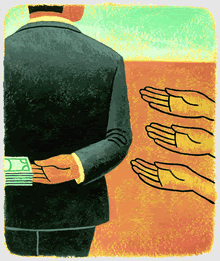
 As Russia struggles to shrug off a corrupt legacy from its Soviet past, businesses are taking a step-by-step approach to managing the “informal practices” putting their companies at risk
When Russians were identified as the world’s most prolific bribe takers in a 2011 Transparency International index, it came as no surprise. Since the days of the Soviet Union, corruption and informal practices have been considered part of the intricate web of Russian life. But as globalisation intensifies calls for transparency, companies operating in the region are under pressure from investors to stamp out the kick-backs and conflicts of interest hitting their bottom lines.
Corruption is estimated to add 20-30 percent to the cost of doing business in post-Soviet countries and industry is as much the villain as the victim, helping create an ecosystem of “informal practices” that flourished with the transition to a free-market economy.
See full Article.
As Russia struggles to shrug off a corrupt legacy from its Soviet past, businesses are taking a step-by-step approach to managing the “informal practices” putting their companies at risk
When Russians were identified as the world’s most prolific bribe takers in a 2011 Transparency International index, it came as no surprise. Since the days of the Soviet Union, corruption and informal practices have been considered part of the intricate web of Russian life. But as globalisation intensifies calls for transparency, companies operating in the region are under pressure from investors to stamp out the kick-backs and conflicts of interest hitting their bottom lines.
Corruption is estimated to add 20-30 percent to the cost of doing business in post-Soviet countries and industry is as much the villain as the victim, helping create an ecosystem of “informal practices” that flourished with the transition to a free-market economy.
See full Article.
Saturday, June 30, 2012
Corruption: A piecemeal solution
As Russia struggles to shrug off a corrupt legacy from its Soviet past, businesses are taking a step-by-step approach to managing the “informal practices” putting their companies at risk
When Russians were identified as the world’s most prolific bribe takers in a 2011 Transparency International index, it came as no surprise. Since the days of the Soviet Union, corruption and informal practices have been considered part of the intricate web of Russian life. But as globalisation intensifies calls for transparency, companies operating in the region are under pressure from investors to stamp out the kick-backs and conflicts of interest hitting their bottom lines.
Corruption is estimated to add 20-30 percent to the cost of doing business in post-Soviet countries and industry is as much the villain as the victim, helping create an ecosystem of “informal practices” that flourished with the transition to a free-market economy.
See full Article.







 Posts
Posts