Showing posts with label Trade. Show all posts
Showing posts with label Trade. Show all posts
Tuesday, June 30, 2015
Saturday, January 10, 2015

Tuesday, December 16, 2014
Wednesday, January 29, 2014
Thursday, January 16, 2014
Wednesday, January 01, 2014
Wednesday, November 27, 2013
WTO issues panel reports on EU measures on seal products
On 25 November 2013, the WTO issued the panel reports in the dispute “European Communities — Measures prohibiting the importation and marketing of seal products”
This dispute concerns regulations of the European Union (“EU Seal Regime”) that generally prohibit the import and placing on the market of seal products. The EU Seal Regime provides for various exceptions to the prohibition if certain conditions are met, including for seal products derived from hunts conducted by Inuit or indigenous communities (IC exception) and hunts conducted for marine resource management purposes (MRM exception).
The panel determined that the EU Seal Regime is a technical regulation and that the IC exception and the MRM exception under the EU Seal Regime violate Article 2.1 of the TBT Agreement because: (1) these exceptions accord imported seal products treatment less favourable than that accorded to like domestic and other foreign products; and (2) such less favourable treatment does not stem exclusively from legitimate regulatory distinctions. The panel found however that the EU Seal Regime does not violate Article 2.2 of the TBT Agreement because it fulfils the objective of addressing EU public moral concerns on seal welfare to a certain extent, and no alternative measure was demonstrated to make an equivalent or greater contribution to the fulfilment of the objective.
See full Press Release: http://www.wto.org/english/news_e/news13_e/400_401r_e.htm


Thursday, June 20, 2013
Promoting global fairness through trade, taxation and transparency, says President Barroso ahead of G8 Summit

Ahead of the G8 summit, President Barroso sets out his views on the main items on the G8 agenda in the summit magazine published by the G8 Research Group of the University of Toronto.
Strengthening the EU’s economic partnership with the world
This G8 summit in Northern Ireland is particularly emotional. The summit places on the global stage the local and national efforts, supported not least by the European Union, that over two decades have returned peace and reconciliation to this most beautiful and hospitable part of Europe. I would like to commend the United Kingdom presidency for this choice.
It also has a personal significance for me: it was under the last UK presidency of the G8 in 2005 that I attended at Gleneagles my first G8 summit as president of the European Commission.
See full Press Release: http://europa.eu/rapid/press-release_MEMO-13-548_en.htm?locale=en
Wednesday, January 09, 2013
Climate change talks deadlocked on final day of UN summit
Delegates who worked through night fail to agree on key issues such as Kyoto protocol, but remain hopeful of rescuing deal
Talks on a new climate deal ground on through Friday night in Qatar, as countries failed to agree on key issues including: rescuing the Kyoto protocol, finance and compensation for poor countries suffering the effects of climate change, and how to structure a proposed new global climate change agreement.
The negotiations, which have gone on for more than a fortnight, looked set to last for most of Saturday. But the marathon session left many delegates hopeful of rescuing a deal amid the frustration and confusion of the night.
See full Article: http://www.guardian.co.uk/environment/2012/dec/08/climate-change-talks-deadlocked-summit
Monday, December 24, 2012
China launches WTO case against EU solar subsidies | European Voice
Member states are violating international trade rules with their subsidies to solar power, China alleges.
China initiated proceedings against the EU with the World Trade Organisation yesterday (5 November), alleging that some member states are violating international trade rules with their subsidies to solar power.
The move is widely seen as a response to the anti-dumping probe launched by the EU against China in September. The probe is in response to complaints from European companies that Chinese companies are selling their photovoltaic components on the EU market for well below what it costs to make them.
See full Article: http://www.europeanvoice.com/article/2012/november/china-launches-wto-case-against-eu-solar-subsidies/75596.aspx
Saturday, December 08, 2012
Doha climate talks – as it happened
News and analysis as the UN climate talks draw to a close in Doha with agreement still needed on several key issues
Final day of UN climate talks
It's officially the last day of the UN climate talks in Qatar, where nearly 200 countries have spent the past fortnight working to agree the next steps to a future climate treaty to be nailed down in 2015.
However, in the tradition of recent years of talks, where the negotiations have run over by hours and even days, we're already hearing that a final agreement is not expected until Saturday, perhaps around noon. As our environment correspondent, Fiona Harvey, tells me that's disappointing considering this was considered a housekeeping conference whose aims were all "eminently doable".
See full Article: http://www.guardian.co.uk/global/2012/dec/07/doha-climate-talks-final-day-live
Thursday, July 26, 2012
Trade: Greener export credit rules approved
 OECD countries have agreed new rules to strengthen current environmental and social due diligence processes when providing export credits and to create financially prudent incentives to support business projects with low CO2 emissions. The second agreement also aims to encourage support for advanced climate-friendly technologies such as carbon capture and storage.
The first agreement is an OECD Recommendation that broadens and enhances the provisions for addressing environmental and social issues relating to the export of capital goods and services qualifying for official export credits. This agreement updates and improves a 2007 Recommendation.
The new Recommendation provides clarity to existing disciplines and aims to promote international coherence. It reflects recent developments in the fields of environmental, social and governance due diligence, such as measuring greenhouse gas emissions and addressing project-related human rights impacts, in reviews of environmentally and socially sensitive projects.
See full Press Release.
OECD countries have agreed new rules to strengthen current environmental and social due diligence processes when providing export credits and to create financially prudent incentives to support business projects with low CO2 emissions. The second agreement also aims to encourage support for advanced climate-friendly technologies such as carbon capture and storage.
The first agreement is an OECD Recommendation that broadens and enhances the provisions for addressing environmental and social issues relating to the export of capital goods and services qualifying for official export credits. This agreement updates and improves a 2007 Recommendation.
The new Recommendation provides clarity to existing disciplines and aims to promote international coherence. It reflects recent developments in the fields of environmental, social and governance due diligence, such as measuring greenhouse gas emissions and addressing project-related human rights impacts, in reviews of environmentally and socially sensitive projects.
See full Press Release.
Thursday, March 22, 2012
US imposes solar duties on China because of subsidies
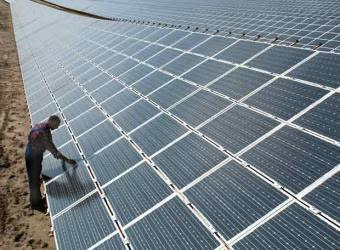
The US has imposed duties on Chinese solar panel manufacturers after it said that they received unfair subsidies.
Chinese exporters into the US - including Suntech - will now face customs tariffs of between 2.9% and 4.73%, the Commerce Department said.
In 2011, imports of solar cells from China into the US were valued at $3.1bn (£1.96bn), it added.
See full Article.
Saturday, November 26, 2011
APEC Forum | Trade Agreement
 ASIA-PACIFIC nations including Australia have put green energy initiatives at the heart of a new pact aimed at bridging gaps between their economies while bolstering trade opportunities across the region.
A pledge to cut tariffs to 5 per cent by 2015 on green goods - and to make their economies less energy intensive - led a range of initiatives signed off by leaders of the 21-member Asia-Pacific Economic Co-operation forum meeting in Hawaii.
They also committed to a ''seamless regional economy'' by agreeing to align regulatory systems and simplify travel rules.
See full Article.
Sunday, June 12, 2011
China threatens trade war over EU emissions trading scheme

China has threatened a damaging trade war with the European Union if Brussels pushes ahead with plans to include foreign airlines in its emissions trading scheme, as the boss of British Airways's parent company warned that passengers could be caught up in a tit-for-tat conflict.
See full Article.
Sunday, May 22, 2011
The Appeal of Fair Trade Bananas

Following Fair Trade: Even the most locally minded eaters tend to consume some foods and beverages that only grow in distant regions—usually the hot and tropical ones—and many of those areas are also home to some of the world’s poorest populations. To ensure people at the origin of global supply chains receive just treatment, adequate pay, and access to health, education and a good quality of life, the Fair Trade standard was created. Fair Trade regulations often have positive environmental consequences, but at the root protects people—facilitating farming practices and trade relationships that empower farmers and their communities.
See full Article.
Saturday, April 09, 2011
Towards “Fair Trade Microfinance”

Creating a standard to recognize MFIs that are serving the poor
The Microcredit Summit Campaign recently announced development of a proposed new Seal of Excellence for Poverty Outreach and Transformation in Microfinance. Intended as a sort of “fair trade designation” for microfinance institutions, the Seal of Excellence would recognize superior performance by microfinance institutions (MFIs) which combine financial sustainability with both significant outreach among poor clients and with a strategic approach to poverty reduction and transformation.
The concept note Beyond ‘Ethical’ Financial Services describes the Seal of Excellence (Seal) as an idea "to set a vision for the sector in terms which highlight the potential of microfinance to serve the poor and to contribute to positive transformation in the lives of clients, their families and communities; and to provide a means of recognizing MFIs that are implementing this vision.
See full Press Release.
Thursday, April 07, 2011
Ethical trade champions call for government to take ‘moral lead’ on ethical procurement

At a staggering £125bn, public spending on goods and services - anything from catering and cleaning services to police truncheons and nurses uniforms - dwarfs that of the private sector. Yet many of the people who produce those goods and services toil for long hours in dangerous conditions, for poverty wages. For example, thousands of children in Pakistan are known to be involved in making surgical instruments destined for the UK.
See full Article.
Sunday, March 27, 2011
Trade Freedom Continues to Advance—Barely
Abstract:
The Heritage Foundation began ranking trade freedom around the world in 1995. The newest rankings (to appear in the 2011 Index of Economic Freedom) show global trade freedom as high as it has ever been. That is encouraging: Countries with higher levels of trade freedom have higher levels of economic prosperity. Still, the latest average score showed only a slight improvement, and far too many people continue to live in poverty because their political leaders have blocked attempts at opening paths to freer trade. Countries should reduce trade barriers that protect politically powerful elites at the expense of the general population. More free trade leads to higher incomes, more jobs, and greater equality. Heritage Foundation trade policy experts Bryan Riley and Ambassador Terry Miller lay out the facts.
The 2011 rankings of trade freedom around the world, developed by The Heritage Foundation as part of its annual Index of Economic Freedom, show average trade freedom at its highest level to date.[1] Since 1995, the average score out of a possible 100 has grown from 56.7 to 74.8—an impressive 31.9 percent improvement over the 17-year period. The average score improved 0.6 point from the 2010 rankings, a significant achievement given the worldwide recession from which most countries were emerging.
See full Article.
Sunday, October 10, 2010
Currency Wars: China Should Impose Green Taxes on its Exports
Currency wars: China should impose green taxes on its exports, by Gérard Roland, Vox EU: US and European policymakers have been clamoring about starting a currency war against China to force it to appreciate its currency. Even Paul Krugman, whose economic insights have been so precious in the Great Recession, is loudly supporting the Levin bill giving the Obama administration more power to impose tariffs on Chinese imports. A lesson from the Great Depression was that moves to impose tariffs on one’s competitors spiral into a global trade war that brings international trade into a nosedive and leads to even more global economic misery.
See full Article.
Subscribe to:
Posts (Atom)






 Posts
Posts