Saturday, April 30, 2011

Gambling with the Planet


The consequences of the Japanese earthquake – especially the ongoing crisis at the Fukushima nuclear power plant – resonate grimly for observers of the American financial crash that precipitated the Great Recession. Both events provide stark lessons about risks, and about how badly markets and societies can manage them.

Of course, in one sense, there is no comparison between the tragedy of the earthquake – which has left more than 25,000 people dead or missing – and the financial crisis, to which no such acute physical suffering can be attributed. But when it comes to the nuclear meltdown at Fukushima, there is a common theme in the two events.

See full Article.

Youth join green jobs push in China


Yang Shumbo, a Chinese electronic sciences student invented a device to save electricity. He developed this into a business under a pilot project of the Greener Business Option (GBO), an ILO Green Jobs Programme initiative. GBO aims to encourage entrepreneurship in green businesses among young people. Report from Chengdu, China, by Satoshi Sasaki, Specialist on Enterprise Development and Job Creation, ILO Beijing and Vincent Jugault, Senior Specialist in Environment and Decent Work, ILO Bangkok.
Article | February 15, 2011

Many will have heard the old joke: ‘How many people does it take to change a light bulb?’

In Chengdu, China, Yang Shumbo, a third year electronic sciences student has shown that just one person can change the way we change light bulbs everywhere.

While energy-saving light bulbs have been around for years, Mr. Yang has developed a device to further reduce electricity consumption. Regular electric bulbs are replaced with Light Emitting Diodes (LED) bulbs, coupled with a small controller designed to reduce electricity consumption. The device regulates variations in temperatures and resistance associated with the semiconductor diode operating in LED light bulbs. As a result, the LED intelligent control system was born and developed into Mr. Yang’s business idea.

See full Press Release.

The Global Economy’s Corporate Crime Wave


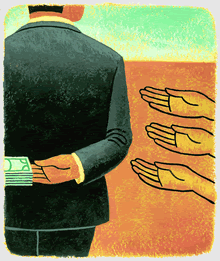
The world is drowning in corporate fraud, and the problems are probably greatest in rich countries – those with supposedly “good governance.” Poor-country governments probably accept more bribes and commit more offenses, but it is rich countries that host the global companies that carry out the largest offenses. Money talks, and it is corrupting politics and markets all over the world.

Hardly a day passes without a new story of malfeasance. Every Wall Street firm has paid significant fines during the past decade for phony accounting, insider trading, securities fraud, Ponzi schemes, or outright embezzlement by CEOs. A massive insider-trading ring is currently on trial in New York, and has implicated some leading financial-industry figures. And it follows a series of fines paid by America’s biggest investment banks to settle charges of various securities violations.

See full Article.

Indigenous women break traditional barriers by becoming entrepreneurs


An ILO/UNDP project to help women in Jayawijay, Lani Jaya and Yahukomo regencies of Papua, Indonesia become entrepreneurs to help lift them out of the poverty line.

There is an old proverb in Papua; Nyeki Awa Loh Halok, Nyape Awalok Hat, or “If the hand does nothing, the mouth will be not chewing”.

It is a saying Serlina Wenda knew only too well - with a husband, a grandmother, a sister, and six children to feed. As an indigenous Papuan woman she was expected to focus on providing food for her children and serving her husband. But - like many women in traditional, patriarchal societies - her low status in the tribal hierarchy and poor education meant she was treated as second-class member of society, playing no part in decisions or her community’s development process.

See full Press Release.

Conventional gas-powered cars starting to match hybrids in fuel efficiency


The new Chevrolet Cruze Eco can reach eye-popping fuel economy levels of more than 50 miles per gallon on the highway, which even in this era of hybrid-electric cars stands among the best.

But here’s the real trick: The Cruze Eco is neither a hybrid nor electric. It runs on that “old” technology, the conventional gasoline engine.

Although hydrogen, electric and other alternative cars have garnered more hype and significant federal subsidies, the best immediate hope for restraining the nation’s fuel consumption might be some new vehicles that, although powered by conventional engines, run efficiently because they have been stripped of unnecessary weight, streamlined to move smoothly and equipped with gas-sipping engines.

See full Article.

Seven Steps to Prevent Recurring Food Crises


Extreme weather events that disrupt harvests lead to rising food prices, hitting hard the world’s poor who spend the majority of their incomes on food. The poor often work in agriculture, but rising costs of inputs and consumer resistance against rising prices “can reduce farmers’ profit margins, distort long-term planning and dampen investment in improved productivity,” explains Shenggen Fan for the Jakarta Post. Fan recommends governments to tackle known challenges with a comprehensive approach: curtailing subsides and reforming policies on biofuels; adding social protections to prevent hunger, eliminating export restrictions and enhancing trade transparency; discontinuing import tariffs and non-tariff barriers; promoting agriculture among small stakeholders; establishing international humanitarian emergency grain reserves and investing in climate-change adaptation and mitigation. Fan urges international food, agriculture and trade groups to join governments in scrutinizing energy needs and other aspects of production, consumption and trade and preparing before the next crisis hits. – YaleGlobal

See full Article.

Energy saving now on the front burner: carbon trading


SPIRALLING energy prices, new regulations and a coming price on carbon are forcing property owners, managers and listed property trusts to look seriously at their energy usage and levels of investment into energy efficiency solutions.

The central questions that are being asked across the sector are: how bad might this situation get, and do the price increases justify new investment into efficiency solutions that can hedge against the rises?

Commercial properties in cities on the east coast of Australia will likely experience a 25 per cent increase in electricity prices in the current financial year. Perth and Darwin can only scoff at the modesty of these numbers.

See full Article.

Friday, April 29, 2011

Main purpose of carbon tax lost in the politics


THE government's proposed carbon tax is being asked to do a lot.

It's supposed to: (1) reduce greenhouse gas emissions; (2) include "compensation" for some trade-exposed industries; and (3) finance compensation for households. Ross Garnaut also (4) wants it to finance other tax reforms included in the Henry Review, and (5) provide $3 billion a year for low emissions technology innovations.

A cash-strapped government promising to get the budget back into surplus shouldn't promise too much for its carbon tax. Its budget credibility will suffer.

See full Article.

Boom and bust signals ecosystem collapse


An experiment in a US lake suggests that ecosystem collapses could be predicted, given the right monitoring.

Researchers changed the structure of the food web in Peter Lake, in Wisconsin, by adding predatory fish.

Within three years, the fish had taken over, producing a decline in tiny water plants and an explosion in water fleas.

See full Article.

UN Women's head Michelle Bachelet: A new superhero?


She wants more female peacekeepers and an end to violence against women. Meet Michelle Bachelet, the former Chilean president and now head of the UN's new women's rights body

Let it not be said that those wags at the United Nations don't have a sense of humour. Given the task of finding an office for its new women's rights body, the premises managers found some space in the iconic Daily News building – otherwise known as the home of Superman.

But now, instead of Clark Kent, the world has Michelle Bachelet – taking on the superhuman challenge of redressing gender inequality. Unlike the last son of Krypton, relatively little is known about Bachelet outside her native Chile and the corridors of international diplomacy.

See full Article.

U.K. Bribery Act Requires New Precautions for Global Companies


The U.K. Bribery Act 2010 taking effect July 1 represents one of the biggest changes in global anticorruption law since the USA Patriot Act in 2001, but awareness of its provisions remains very low, according to a Deloitte webcast poll.

While 78% of respondents who participated in the poll said there will be greater global anticorruption enforcement in the next year, nearly as many (73%) said they are unfamiliar with provisions in the U.K. Bribery Act.

But U.S. companies with offices or sales activities in the U.K. need to get up to speed with its provisions, experts warn, since the law applies both to companies that are incorporated in the U.K. as well as companies that conduct business there, whether they have a physical presence in the country or not.

See full Article.

Democracy and Good Governance in the Black Sea Regions


About this report
The Black Sea region is increasingly becoming a priority on the international agenda. In fact, a regional approach is emerging as actors understand that common problems need to be addressed jointly. Nevertheless, cooperation efforts are hampered by a number of factors, such as uneven economic and political development within and among countries, nationalist forces, and longstanding animosities between regional players. In this context, it is imperative to foster sound policies aimed at strengthening dialogue and cooperation so as to contain and ultimately resolve conflicts with peaceful means. However, there is little policy-oriented research on the challenges and opportunities for cooperation in the Black Sea region. The Commission on the Black Sea aims to redress this imbalance by presenting a series of four policy-oriented reports which reassess the economic, social, regional political and military developments in the region. This report is the fourth one, providing a better understanding of the current status of transformation towards democracy and good governance in the countries of the Black Sea region. The Commission on the Black Sea does not take a collective position with this paper. This text represents only the views of its authors.

See full Report, in pdf format.

Japan's winds of change


ONE reason for Japan’s reliance on nuclear power—with all its attendant difficulties of building reactors safely in an earthquake zone—is its lack of indigenous energy sources. Yet it does have one that seems under-exploited, namely the wind. According to a report published in 2009 by the Global Wind Energy Council, Japan, which generates 8.7% of the world’s economic output, has just 1.3% of its capacity to make electricity from the air. The world’s third-largest economy, then, is 13th in the world’s windpower league table.

According to Chuichi Arakawa, a mechanical engineer at the University of Tokyo, that is because Japan has too much of the wrong sort of wind. First, the typhoons which regularly strike the place are simply too powerful. (In 2003, for example, such a storm crippled six turbines on Miyakojima, near Okinawa.) Second, the regular winds that blow through the country are less useful than they might be because Japan is so mountainous.

See full Article.

Thursday, April 28, 2011

Powerful savings

JAPAN has been dreading a major energy shortage in the north-east, after a quarter of the region's power-generation capacity was damaged by the quake, tsunami and crisis at the Fukushima nuclear power plant. But a summer of rolling blackouts may be avoided.

TEPCO, the Tokyo regional power company, has been able to bring online more power plants than it anticipated initially. Instead of an 8-gigawatt (8GW) shortfall, it now expects to suffer a shortage of only 3GW, as a story in this week's paper explains. Demand is estimated to peak at 55GW, which leaves room for basic energy-saving measures, like using less air-conditioning and lighting, to avert a power crunch with capacity to spare.

See full Article.

How Do I Know If My Company Is Compliant If I Don’t Know Every Applicable Law and Regulation?


This is one of the hardest questions to answer since you just don’t know what you don’t know. Knowing all of the laws and regulations that an organization must comply with is a basic tenet of an ISO 14001-certified Environmental Management System and the foundation of any compliance assurance system, yet it is the most difficult task to accomplish.

This is because within any country, there exist – in addition to the governmental body that creates law – many regulatory agencies that are chartered with putting the rules of operation into play. Just trying to find out who those agencies are and where they list their regulations can be a daunting task in itself.

See full Article.

Growth in emission transfers via international trade from 1990 to 2008


Abstract

Despite the emergence of regional climate policies, growth in global CO2 emissions has remained strong. From 1990 to 2008 CO2 emissions in developed countries (defined as countries with emission-reduction commitments in the Kyoto Protocol, Annex B) have stabilized, but emissions in developing countries (non-Annex B) have doubled. Some studies suggest that the stabilization of emissions in developed countries was partially because of growing imports from developing countries. To quantify the growth in emission transfers via international trade, we developed a trade-linked global database for CO2 emissions covering 113 countries and 57 economic sectors from 1990 to 2008. We find that the emissions from the production of traded goods and services have increased from 4.3 Gt CO2 in 1990 (20% of global emissions) to 7.8 Gt CO2 in 2008 (26%). Most developed countries have increased their consumption-based emissions faster than their territorial emissions, and non–energy-intensive manufacturing had a key role in the emission transfers.

See full Abstract.

The Power of Effective Leadership


As leaders and managers in the compliance and ethics field, we spend our days tackling the challenges of building a more “effective” compliance and ethics program. We share lessons learned and best practices at conferences, support research, develop tools and metrics, and then try to implement those improvements in our companies and organizations.

Are we spending enough time, though, considering and improving our own effectiveness as leaders? Do we take the time to ask the fundamental question, “What does it mean to lead?” Even the “best” policy or program on paper requires insightful, active leadership to bring it to life and integrate it into the business operations and behaviors from which most ethical or compliance risks arise.

See full Article.

Concern About Corruption Liability Leads Companies to Abandon Business Partners in Foreign Markets


Survey Finds that More Than 55% of Companies Delay or Avoid Working with Global Business Partners; More Than 40% of Companies Have Lost Business to Competitors That Won Contracts Unethically

More than half of the companies doing business internationally are shelving key business partnerships due to concerns about corruption liability in foreign markets, according to this year’s Dow Jones State of Anti-Corruption Survey. The bi-annual survey, which surveyed more than 300 companies worldwide, also found a marked increase in the number of companies claiming to have lost business due to competitors acting unethically – from 10% in the 2009 study to 40% today.

See full Article.

So You Want to Become a Whistleblower? 5 Things to Consider Before Doing So


Society owes much to whistleblowers. Whistleblowers – herein meaning persons who allege to government authorities (either to civil or law-enforcement agencies or in qui tam lawsuits) specific wrongdoing by or within a private company – play a key role in uncovering, stopping and punishing malfeasance by companies.[1] Whistleblowing can be an honorable undertaking, not only because it is a key weapon against such misconduct, but also because it often requires great courage, given that it may result in retaliation and backlash generally.

However, honor is hardly the only incentive for would-be whistleblowers to overcome their apprehension and report wrongdoing to the government. There is a more prosaic and practical incentive: money.

See full Article.

What Behavioral Ethics Means for Compliance and Ethics Programs


“The spirit of liberty is the spirit which is not too sure that it is right,” Judge Learned Hand once said, and the same may be true (at least in part) for the spirit of compliance and ethics (C&E). That is but one lesson that might be drawn from the emerging and important field of “behavioral ethics,” which teaches that for many reasons we tend to overestimate our ability to do what is right.

In Blind Spots: Why We Fail to Do What’s Right and What to Do about It (published last month by Princeton University Press), business school professors Max H. Bazerman of Harvard and Anne E. Tenbrunsel of Notre Dame provide an overview of behavioral ethics that is both concise but also brimming with intriguing and useful information. In my view, every C&E professional should read this book and strive to apply it’s insights to their respective companies’ C&E programs.

See full Article.

Wednesday, April 27, 2011

Evolution of carbon sinks in a changing climate


Abstract

Climate change is expected to influence the capacities of the land and oceans to act as repositories for anthropogenic CO2 and hence provide a feedback to climate change. A series of experiments with the National Center for Atmospheric Research–Climate System Model 1 coupled carbon–climate model shows that carbon sink strengths vary with the rate of fossil fuel emissions, so that carbon storage capacities of the land and oceans decrease and climate warming accelerates with faster CO2 emissions. Furthermore, there is a positive feedback between the carbon and climate systems, so that climate warming acts to increase the airborne fraction of anthropogenic CO2 and amplify the climate change itself.

See full Abstract.

The cost of trade

Rich countries are outsourcing carbon-dioxide emissions

WHEN a country reports its carbon emissions to the United Nations, it is the carbon dioxide that goes out of chimneys, exhaust pipes and forest fires of the country’s own territory that gets counted. But what about the carbon emitted elsewhere by people making goods that the country imports? A paper just published in PNAS by Glen Peters and colleagues from Cicero, a research group, looks at how the world’s carbon emissions get reapportioned when the carbon used to make traded goods and services is charged against the account of the ultimate consumer, not the initial producer.

See full Article.

Sustainable Insight


The financial crisis has changed the way mainstream investors think about long-term value creation and has renewed their attention towards corporate responsibility and behaviour. Although the majority of public companies issue Sustainability reports, there is a general consensus that companies are not communicating effectively with a broader set of mainstream investors on Environmental Social & Governance (ESG) factors.

In this edition of Sustainable Insight we explore the emerging trends within the investment community and determine the implications for businesses in terms of how they manage ESG factors and communicate to investors.

See full Details.

SEC Forum to Address Benefits, Challenges of IFRS for U.S.


The SEC on Wednesday said it is hosting a round-table meeting July 7 to discuss benefits or challenges in potentially incorporating IFRS into the financial reporting system for U.S. issuers.

The SEC said in a press release that the meeting will include three panels representing investors, smaller public companies, and regulators. The panel discussions will focus on topics such as investor understanding of IFRS and the impact on smaller public companies and on the regulatory environment of incorporating IFRS.

See full Article.

10 Most Corrupt State Governments


It seems that political corruption is influenced by several intrinsic factors that are almost impossible to change. Some states have struggled with the same issues of embezzlement, extortion and bribery for centuries, and have done little to change for the better, which explains why, as Americans, we’re perpetually cynical about our elected officials, despite purporting ourselves to be a moral beacon for the world. Charles Caleb Colton said it best: "Corruption is like a ball of snow; once it’s set a rolling, it must increase." The following state governments are proof of that, as their politicians have routinely made headlines for their wrongdoings. Hopefully, some day, each will undergo a sort of moral cleansing and make changes for the better.

See full Article.

6 Ways Companies Can Avoid the Regulatory Microscope


Blame it on the difficult economy — or the Internet — or maybe even the media. Private sector workplace discrimination charges with the U.S. Equal Employment Opportunity Commission (EEOC) hit another all-time high during the 2010 fiscal year.

Agency officials reported an unprecedented 99,922 charges during the last fiscal year, which ended on September 30, 2010. That’s up from 93,277 workplace discrimination complaints in fiscal year 2009, and the previous high of 95,402 set in fiscal year 2008. All three years now hold the dubious distinction of being the most active on record with respect to discrimination claims.

See full Article.

SEC announces roundtable on IFRS


The U.S. Securities and Exchange Commission (SEC) will hold a roundtable on 7 July in Washington to discuss benefits and challenges in incorporating International Financial Reporting Standards (IFRS) into the financial reporting system for U.S. issuers. The roundtable will feature three panels representing investors, small public companies, and regulators. The focus of the discussion will be on investor understanding of IFRS and the impact on smaller public companies and on the regulatory environment of incorporating IFRS.

See full Press Release.

Tuesday, April 26, 2011

Unsure about nuclear power? Here's the five questions you must answer

Twenty five years on from Chernobyl, the heated debate on nuclear power remains resistant to cold facts: simply too few are known. But making your own judgements on five key questions will lead to your answer

Containing the elemental forces that rage inside a nuclear reactor is one of the great achievements of science, but losing control, as happened 25 years ago on Tuesday at Chernobyl, is one of its greatest failures.

So what to think of nuclear power? People often ask me if I support or oppose the building of new nuclear power stations, presuming I think that because of my job, I'll know the answer. If only it was that easy

See full Article.

Future of Financial Reporting Council up for debate


Roger Marshall, chairman of sub-body the Accounting Standards Board, said the process started in late 2010, when the regulator began considering whether it needs a different focus, and how to make the group work better.

"I think everyone has started thinking about what lessons can be learnt from the financial crisis and its aftermath," he said.

The FRC is made up of six operating bodies, and communication between the groups is one of the primary focuses of the inquiry. The FRC board - which oversees the bodies - is to look into interactions between them, and whether these can be "maximised".

See full Article.

The Threat to Africa's Fledgling Democracy


The yearning for democracy is not enough. Citizens must set high standards for elections – ensuring secret ballots, secure polling places and fair rules – Kofi Annan argues in an opinion essay for the Financial Times. Candidates, too, must accept voters’ decisions. That didn’t happen in Côte d'Ivoire, where Alassane Ouattara was declared winner but President Laurent Gbagbo refused to relinquish his post. Such defiance, if successful, could instigate power grabs by other failed leaders, and the conflict could ignite ethnic divisions that spill over borders. Annan recommends that the African Union and other multinational institutions quickly endorse the results of democratic elections or risk long-term instability. “[T]he crisis in Ivory Coast must also spur global efforts to uphold the integrity of elections wherever they are held,” concludes Annan, urging stiffer penalties for election corruption. “The risk of conflict increases while corruption, intimidation and fraud go unchecked, rotting the entire political system slowly from within.”

See full Article.

Brussels revamps code of conduct


The European Commission has tightened up its code of conduct banning spouses from commissioners' offices and extending the period EU executive members must request approval from Brussels before taking up new jobs once out of office to a year and a half.

The new rules were agreed by the college of commissioners on Wednesday in the wake of a string of ‘revolving door' scandals in 2009 in which six former commissioners went on to well-paid executive positions with lobbying outfits, banks and airlines.

See full Press Release.

Grain boundary mobility of carbon in Earth's mantle: A possible carbon flux from the core


Abstract

The importance of carbon in Earth's mantle greatly exceeds its modest abundance of ≈1,000–4,000 ppm. Carbon is a constituent of key terrestrial volatiles (CO, CO2, CH4), it forms diamonds, and it may also contribute to the bulk electrical properties of the silicate Earth. In contrast to that of the mantle, the carbon content of Earth's metallic core may be quite high (≈5 wt %), raising the possibility that the core has supplied carbon to the mantle over geologic time. The plausibility of this process depends in part upon the mobility of carbon atoms in the solid mantle. Grain boundaries of mantle minerals could represent fast pathways for transport as well as localized sites for enrichment and storage of carbon. Here, we report the results of an experimental study of grain-boundary diffusion of carbon through polycrystalline periclase (MgO) and olivine ([Mg,Fe]2SiO4) that were obtained by determining the extent of solid solution formation between a graphite source and a metal sink (Ni or Fe) separated by the polycrystalline materials.

See full Abstract.

Report on Observance of Standards and Codes-FATF


Recommendations for Anti-Money Laundering and Combating the Financing of Terrorism - Kingdom of the Netherlands-Netherlands

See full Press Release.

Climate change to reduce US West water supply - report


Scarce water supplies in the western US will probably dwindle further as a result of climate change, causing problems for millions in the region, a government report has said.

Climate change could cut water flow in several of the American West's largest river basins by up to 20% this century, the interior department report said.

Those rivers provide water to eight US states, from Texas to California.

See full Article.

Monday, April 25, 2011

China Accounting Landscape

IASB and FASB issue progress report on convergence programme


The International Accounting Standards Board (IASB) and Financial Accounting Standards Board (FASB) have published a progress report on improvements to International Financial Reporting Standards and US generally accepted accounting practices and their convergence. The report notes that the boards have:

Completed five projects — as mentioned in our previous article, the IASB will be issuing new standards on consolidation, joint ventures, and disclosures.
Given priority to the three remaining MoU projects and insurance accounting — the boards have made substantial progress on their projects on financial instruments, leases, revenue recognition, and insurance projects.
Extended the timetable on convergence projects — the convergence projects are now scheduled for completion in the second half of 2011.

See full Press Release.

Carbon emissions 'hidden' in imported goods revealed


The extent of carbon dioxide (CO2) emissions "hidden" in imported goods is growing, according to two studies.

Official statistics do not include emissions created by making imported goods but researchers say they should.

It comes as the Proceedings of the National Academy of Sciences reports 26% of global emissions come from producing goods for trade.

See full Article.

London accounting companies battle to be the greenest


"We're seeing a green arms race between various companies in a whole host of sectors - to be the greenest," says architect Richard Buckingham.

The latest evidence of this race to the top of the eco-league table comes in the form of two new sustainable buildings from two of the biggest accountancy companies in the world.

See full Article.

Kingdom of the Netherlands-Netherlands: Detailed Assessment Report on Anti-Money Laundering and Combating the Financing of Terrorism


See full Press Release.

Reclamation Climate Change and Water 2011


See full Report, in pdf format.

A vueltas con la RSE


Debatía hace unos días con algunos colegas sobre la paradoja de que los mayores avances sociales y laborales se consiguieron cuando la RSE ni siquiera se había "inventado". Y justamente cuando surge y se consagra como la nueva religión que todos - empresarios, políticos y sindicatos - dicen profesar, es precisamente cuando más se está retrocediendo en los derechos conseguidos; curiosamente con el beneplácito de ésos que llenan su boca con la RSE.

Ante lo cual, uno se pone a reflexionar sobre el por qué de la Responsabilidad Social Empresaria y el momento de su aparición. Eran tiempos de expansión, de crecimiento, de beneficios empresariales al alza y de defensa a ultranza de las leyes del mercado y la autorregulación. La crisis aún no había estallado pero ya se estaba gestando.

Ver Artículo completo.

Sunday, April 24, 2011

5 Ways Going Green Can Add a Little Green to Your Wallet - Almost $250 a Month


Celebrating Earth Day by going green can improve the health of our planet and your finances. The Illinois CPA Society offers these ideas for sustainable Earth Day savings:
Drink tap water. The average case of 24 16 oz. bottles of water costs $5.99 (and takes 72 fl oz. of crude oil to make). If you're keeping with the recommended daily amount of 64 oz of water per day, you'd save yourself roughly $365 a year by ditching the bottle and filling up at the tap. Potential monthly savings: Approximately $100.00.

Easy on the gas. With gas climbing up to over $4.00 a gallon, now may be the time to consider mass transit. Check out your local public transit system or ask coworkers if they'd like to carpool. Forking over less cash at the pump also means lower emissions into the air. Potential monthly savings: Approximately $50.00

See full Article.

How the antiwar movement inspired world's largest green campaign


Earth Day was launched 41 years ago today by a US senator who was alarmed by the 1969 Santa Barbara oil spill and inspired by the student antiwar movement.

In the 1960s, student activists seemed more concerned with foreign conflicts such as the Vietnam War than with cleaning up the environment.

Then the largest oil spill in US history occurred off the coast of California, leaking an estimated 100,000 barrels of crude into waters near Santa Barbara in 1969 (it has since been eclipsed in size by Exxon Valdez and the BP Gulf spill). A US senator from Wisconsin visited the site and was so moved by the devastation that he proposed a "national teach-in on the environment."

See full Article.

Why No Warnings? Investors Press Audit Regulator


U.S. investors have finally joined shareholders, regulators, and legislators in the UK to demand one more crisis question be answered:

Where were the auditors during the financial crisis?

The Public Company Accounting Oversight Board (PCAOB), the U.S. accounting and audit industry regulator created by the Sarbanes-Oxley Act of 2002 in the aftermath of the Enron scandal, convened an Investor Advisory Group (IAG) last year to explore issues of interest to the Board’s primary constituency – investors. At a public meeting two weeks ago, the (IAG) presented reports on three issues:

See full Article.

Businesses warned over rise in cyber crime


New research reveals online criminals cost UK business £21bn a year

Businesses are warned today to protect themselves against the rising risk of cyber crime as new research shows the true cost of this 21st century economic threat.

The warning comes from Bluefin Insurance Services which has offices in 50 locations across the country. Peter Castle, Head of Customer Proposition, at Bluefin says: "Cyber crime is an increasingly serious problem but many traditional insurance policies could leave businesses vulnerable in the event of an attack."

See full Article.

US consults on international accounting standards


THE US SECURITIES and Exchange Commission is to hold a roundtable discussion on International Financial Reporting Standards in July.

Representatives from regulators, investors and smaller public companies will be present, and discussions will cover the impact of adoption on businesses and the regulatory environment.

SEC chief accountant James Kroeker said all parties must "carefully consider and deliberate" whether convergence is in the best interests of investors and markets.

See full Article.

London accounting companies battle to be the greenest


"We're seeing a green arms race between various companies in a whole host of sectors - to be the greenest," says architect Richard Buckingham.

The latest evidence of this race to the top of the eco-league table comes in the form of two new sustainable buildings from two of the biggest accountancy companies in the world.

See full Article.

10 reasons you should still be angry about the BP oil spill

SME accounting standards poised for international revamp


THE CONSULTATION on international financial reporting standards for SMEs concludes at the end of April, and the signs point to change on the horizon.

Stakeholders were first invited to comment on the Accounting Standards Board's consultation document in October. Chairman Roger Marshall said around 20 written replies have been received so far.

However, the body has also been doing "lots of outreach", bringing up the issue of SME reporting rules at around 35 meetings, and receiving plenty of oral feedback.

See full Article.

Saturday, April 23, 2011

New Greenpeace report digs up the dirt on Internet data centres


For most of us, when we think about our environmental footprint, the first things that spring to mind are how to commute to work, the kind of bags we use for grocery shopping, or the detergents we wash our clothes with. But how often do we consider the energy we use when surfing or searching the web? And how how much polluting, dirty energy does our Facebook profile generate?

"How dirty is your data?" is the first ever report on the energy choices made by IT companies including Akamai, Amazon.com (Amazon Web Services), Apple, Facebook, Google, HP, IBM, Microsoft, Twitter, and Yahoo, and highlights the need for greater transparency from global IT brands on the energy and carbon footprint of their Internet infrastructure.

See full Article.

Apple named 'least green' tech company


Greenpeace report puts Apple at bottom of green league table due to reliance on coal at data centres

Apple has come bottom of the most comprehensive green league table of technology companies because of its heavy reliance on "dirty data" centres.

The list, which is compiled by Greenpeace and released in San Francisco on Thursday, shows that the company relies heavily on highly polluting coal power at the sites that house its banks of servers.

Greenpeace's report, How Dirty is Your Data? reveals that the company's investment in a new North Carolina facility will triple its electricity consumption, equivalent to the electricity demand of 80,000 average US homes.

See full Article.